Ever reread the same page three times without retaining a thing? Spent hours going over your notes only to forget everything by the next day? Don't worry — the problem isn't your brain, it's your method. Learning how to learn is a skill in itself, and the techniques that follow can change everything.
What does it really mean to learn?
According to researchers André Giordan and Jérôme Saltet, learning isn't just about memorizing. It's about understanding, applying, and sharing knowledge — and above all, making mistakes. Mistakes aren't failures: they're the raw material of learning. If you're not willing to get things wrong, you'll never truly progress.
Three conditions make learning possible: genuinely wanting to learn, being willing to question your assumptions, and having enough self-confidence to persevere. Without motivation, no technique will work.
If you're not willing to make mistakes, you'll never truly learn. Errors aren't ignorance — they're material to work with. — André Giordan & Jérôme Saltet
Your memory is a network, not a filing cabinet
We often picture memory as a storage space that we fill up. In reality, it works like a network: every piece of information is linked to others through associations, images, and emotions. That's why Marcel Proust could see entire years of childhood memories resurface simply by tasting a madeleine — the flavor activated an entire web of connections.
David Ausubel, an educational researcher in the 1960s, demonstrated two essential things: we understand new information better when it connects to what we already know, and we memorize far more easily when information is organized in a clear structure. In other words: the more you learn, the easier it becomes to learn. Your memory gets stronger with use.
Key takeaway: Memory works through association. The more connections you create between pieces of information, the easier they are to recall. This is the fundamental principle behind every technique presented in this article.
First things first: set the right conditions
Your brain doesn't operate in a vacuum. A balanced diet, physical exercise, a tidy workspace, and genuine rest aren't luxuries — they're the foundation of effective learning. And don't forget leisure activities: reading, music, gardening, or dancing stimulate your brain just as much as a study session.
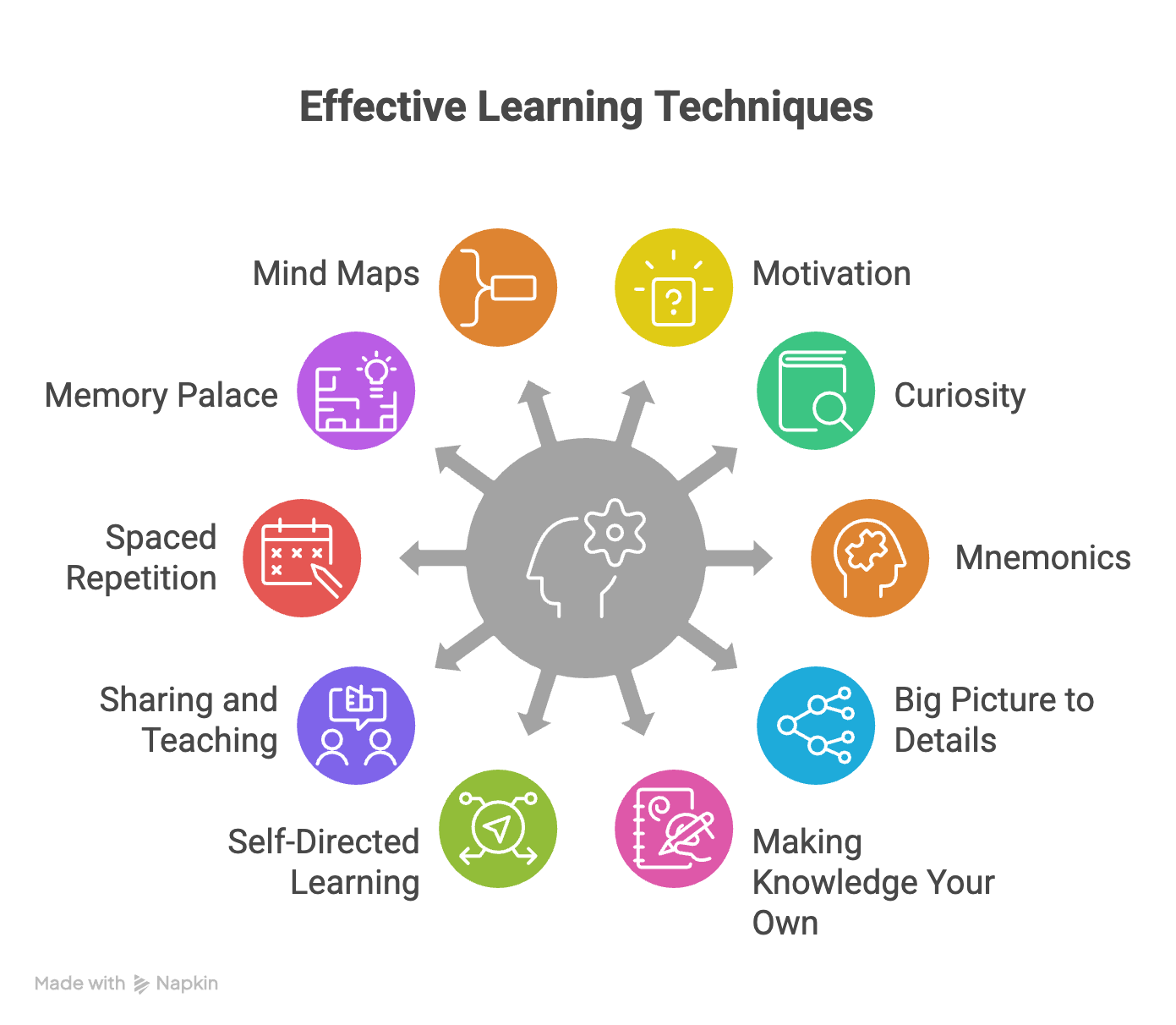
10 techniques to memorize better
Find your motivation
We naturally remember what we enjoy, what moves us, or what's useful to us. Before learning anything, ask yourself: why do I need this? The answer will be your driving force.
Be curious
The brain retains information far better when it's the answer to a question it's already asking. Before reading a chapter, ask yourself questions about the topic — your brain will actively search for the answers.
Use mnemonics
You probably know "Every Good Boy Deserves Fudge" for remembering musical notes on the treble clef. This principle works for everything: turn what you're learning into funny phrases, acronyms, or absurd stories.
Go from the big picture to the details
Always start by understanding the overall picture before diving into the specifics. And vary your sources — reading, listening, and watching a video on the same subject creates multiple connections in your memory.
Make the knowledge your own
Don't just read passively: rewrite, summarize in your own words, organize into categories, identify key terms. This process of rephrasing is itself an act of memorization.
Be a self-directed learner
Build your own learning path based on your interests and needs. Personal discovery is far more motivating than a prescribed curriculum.
Share and teach
Explaining a concept to someone else is one of the most powerful ways to retain it. If you can teach it clearly, it means you've truly understood it.
Use spaced repetition
Information seen only once fades within days. The key is spaced repetition: review every day during the first week, then every two or three days, then once a week, then once a month. Reviewing your notes in the evening is particularly effective because the brain consolidates memory during sleep. The free software Anki automates this system for you.
Build a memory palace (method of loci)
Choose a familiar route — your commute to work, for example. Associate each item you need to remember with a stop along the way, using a vivid mental image. It's the technique Sherlock Holmes uses in the BBC series — and it's been in use since antiquity.
Draw mind maps
Created by Tony Buzan in the 1970s, this method involves placing a central idea in the middle of a page and connecting branches with secondary ideas, using colors and images. The brain works through visualization and association, not in a linear fashion. As Buzan put it: without association, there's no connection; without connection, there's no memory.
The Mind Map is a tool for thinking. It's an external visual representation of what's happening inside the brain. Without association, there's no connection. Without connection, there's no memory. — Tony Buzan
Your turn
You don't need to apply all ten techniques at once. Pick two or three that resonate with you, try them out for a few weeks, and see the difference for yourself. Your memory is a muscle: the more you train it intelligently, the stronger it gets. So — which one will you start with?