

French-English False Friends: The Words That Trick Everyone
My daughters go to school in England. Everything is in English all day — lessons, friends, playground, lunch. Then they come home, and we speak French.
Most of the time, it works fine. But there's one thing that gets them every single time.
"Maman, today we went to the librairie at school."
And every time, I ask the same question: "To buy books or to borrow them?"
"To borrow them, obviously."
"Then it's the bibliothèque, girls. Not the librairie."
We've had this conversation dozens of times. It never sticks. And honestly, I can't blame them — because this one trips up my adult students too.
Why false friends are so tricky
The problem with false friends (les faux amis) is that they feel right. The word looks familiar, it sounds like something you know, and your brain fills in the gap. You don't even stop to question it.
That's what makes them worse than a word you simply don't know. When you don't know a word, you pause, you look it up, you learn it. But with a false friend, you walk straight into the trap with total confidence.
And sometimes, nobody corrects you. They just look a little confused and move on.
The classics
Here are some of the most common French-English false friends that I see in my lessons, over and over again:
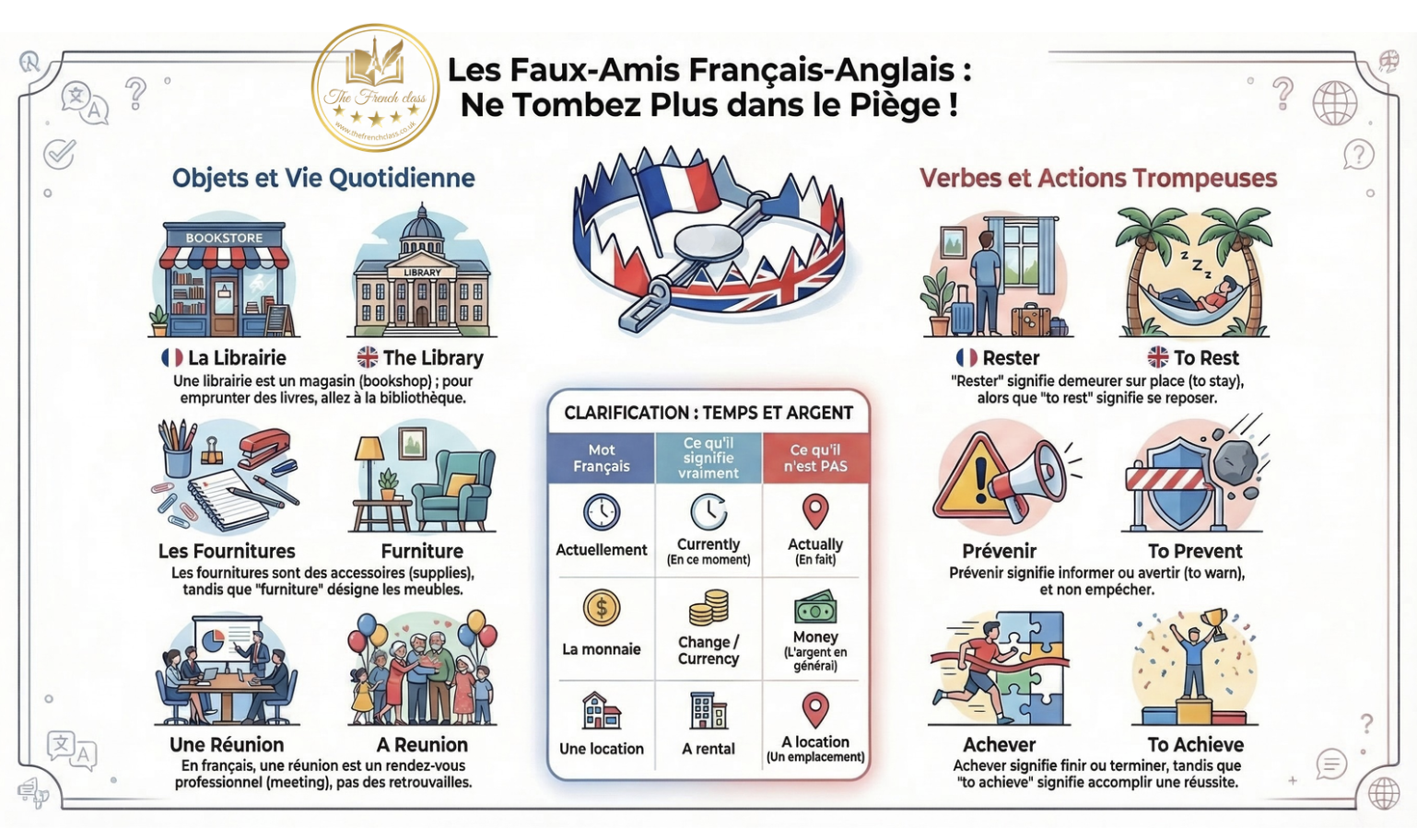
Librairie vs Library
This is the one my daughters keep getting wrong, and for good reason.
🇫🇷 Une librairie = a bookshop (you buy books)
🇬🇧 A library = une bibliothèque (you borrow books)
They look almost identical. They're both about books. But the meaning is completely different.
Actuellement vs Actually
This one causes confusion in almost every professional setting.
🇫🇷 Actuellement = currently, at this moment
🇬🇧 Actually = en fait
So when a French speaker says "I am actuellement working on this project", they mean right now — not "as a matter of fact."
Rester vs To rest
🇫🇷 Rester = to stay, to remain
🇬🇧 To rest = se reposer
"Je vais rester à la maison" means I'm staying home. Not that I'm going to rest at home. Although, let's be honest, sometimes it's both.
Une réunion vs A reunion
🇫🇷 Une réunion = a meeting (usually professional)
🇬🇧 A reunion = des retrouvailles
If your French colleague invites you to une réunion, don't expect cake and old friends. Expect an agenda and a conference room.
Prévenir vs To prevent
🇫🇷 Prévenir = to warn, to inform, to let someone know
🇬🇧 To prevent = empêcher
"Je vais te prévenir" means I'll let you know. Not that I'll stop something from happening.
Achever vs To achieve
🇫🇷 Achever = to finish, to complete (sometimes to finish off — in a dramatic way)
🇬🇧 To achieve = accomplir, réussir
This one can get dark. "Achever quelqu'un" can mean to finish someone off. Not quite the same as achieving your goals.
Why this happens
Most of these false friends exist because French and English share a huge amount of vocabulary — thanks to centuries of history, from the Norman Conquest to modern-day borrowings.
The words come from the same root, but they evolved differently in each language. Over time, meanings drifted apart. The spelling stayed close, but the sense didn't.
That's why your brain trusts them. They look like old friends. But they're not.
How to deal with them
There's no magic trick. But a few things help:
1. Learn them in pairs. Don't just learn the French word — learn it alongside the English word it gets confused with. That way, your brain flags the difference.
2. Learn them in context. A word in a sentence sticks better than a word on a list. "Je vais rester ici" is easier to remember than "rester = to stay."
3. Laugh about it. Seriously. The best way to remember a false friend is to get it wrong in a memorable way. My daughters will probably never forget librairie vs bibliothèque — because we've joked about it so many times.
The takeaway
If you're learning French, you will fall into these traps. It's not a question of if, it's when. And that's completely normal.
The good news? Once you spot them, you never really forget. They become little moments of "oh wait, I know this one" — and that's when you know you're actually making progress.
And if you're ever unsure whether it's a librairie or a bibliothèque, just ask yourself: am I buying or borrowing?
Works every time.
